
How to organise evidence for a legal matter: a practical starting point
When evidence is spread across months of messages, emails, screenshots and documents, knowing where to start can be the hardest part.
The aim isn't to create the perfect filing system or decide for yourself what will matter legally. It's to create a clear, organised record: one that preserves the original information and its context, helps you follow what happened, and makes it easier to find what you need.
This guide takes you through how to do that, step by step.
Start with the record, not what you think proves your case
One of the easiest mistakes to make is to start by pulling out the messages, screenshots or documents that seem most important.
But organising evidence isn't just about collecting individual pieces. It's about preserving the record around them.
A screenshot might capture the message you remember but leave out what came before or after it. Copied text can lose its source. A document renamed or moved without a consistent system can become difficult to trace later.
So before you start selecting, summarising or categorising information, make sure you have the underlying record and can identify where it came from.
That doesn't mean everything you keep will ultimately be relevant or need to be shared. Deciding what should be relied on in a legal matter is a separate question.
For now, the goal is straightforward: know what you have, know where it came from and make sure you can find it again.
Do's and don'ts when organising evidence
| Do | Avoid |
|---|---|
| Keep the original material where possible | Relying only on selected or cropped screenshots |
| Keep track of where information came from | Copying information without retaining its source |
| Preserve dates and surrounding context | Saving isolated snippets that may be difficult to understand later |
| Organise the record before trying to reduce it | Immediately deciding what does or doesn't matter |
| Keep your own notes separate | Mixing your interpretation into the original record |
Step 1: Bring together what you already have
Start by working out what you have and where it is.
Your information might be spread across:
- WhatsApp, text messages or other messaging apps
- Emails
- Photographs and screenshots
- Letters and PDFs
- Financial or other records
- Documents received from another person or organisation
- Notes you've made yourself
- Existing court or case documents
You don't need to start moving thousands of files around. First, create a simple inventory of the main sources, a bit like the example below.
| Source | What you have | Period covered | Where it’s stored |
|---|---|---|---|
| Conversation with Person A | Jan 2025-present | Phone / exported chat | |
| Emails with Person B | Mar-Aug 2025 | Email account | |
| Documents | Letters and PDFs | Various | Laptop |
| Photos | Photographs relating to events | Various | Phone |
This gives you a view of the record before you start working through it piece by piece. It may also expose gaps, an older phone containing part of a conversation, for example, or documents stored in another account.

Step 2: Keep the originals
As you start organising information, don't let your working version replace the original.
Think of them as two separate things:
The original record is the message, email, photograph, document or file itself.
Your working record is how you organise, label, summarise or make notes about that information.
If you screenshot a WhatsApp message, keep the underlying conversation too. If you rename a copy of a document so it's easier to recognise, retain the original file. If you summarise an email exchange, keep the emails behind the summary.
The principle is simple: you should be able to get back to the source.
There may also be specific requirements around documents and evidence depending on the type of legal proceedings involved. If you're preparing material for court rather than simply organising your own records, check the rules that apply or ask your legal adviser.
Step 3: Keep dates, people, sources and context connected
A message can look very different when it's separated from the conversation around it.
Take this:
“That's not what we agreed”
You may know exactly who said it, what they were responding to and why it matters to you. Someone reviewing it months later doesn't.
When you organise information, keep enough context to answer the basics:
- Who was involved?
- When did it happen?
- Where did the information come from?
- What came immediately before or after it?
- Can you get back to the original source?
That doesn't mean adding your interpretation to every item. What the record says and what you think it means are two different things. Keeping those separate makes the information easier for someone else to review. For example:
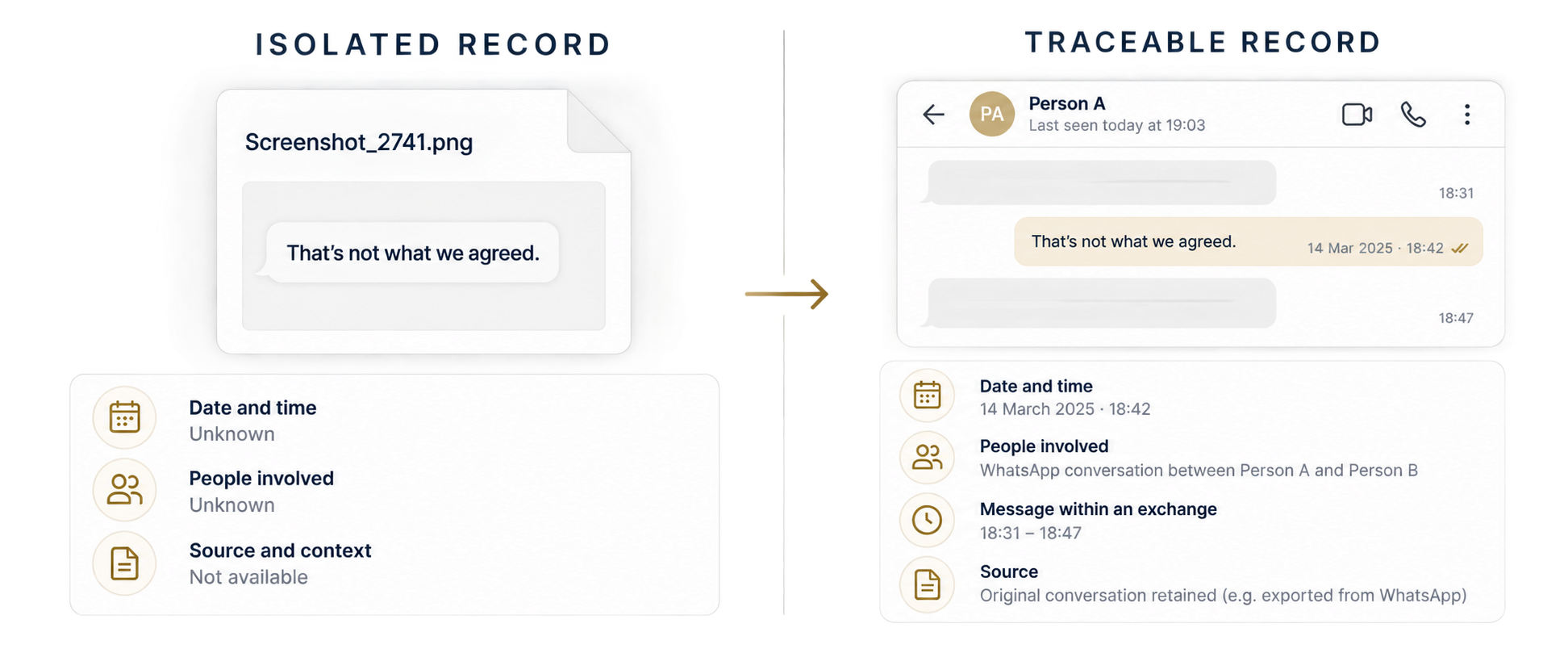
Read the comparison in text
Isolated record
Screenshot_2741.png
That’s not what we agreed.
- Date and time
- Unknown
- People involved
- Unknown
- Source and context
- Not available
Traceable record
That’s not what we agreed.
- Date and time
- 14 March 2025 · 18:42
- People involved
- WhatsApp conversation between Person A and Person B
- Message within an exchange
- 18:31 to 18:47
- Source
- Original conversation retained (e.g. exported from WhatsApp)
The message hasn't changed. The difference is that someone can now understand where it sits in the wider record.
Step 4: Give the information a consistent structure
Once you know what you have and have preserved the underlying material, make it easier to navigate.
There isn't one perfect filing system for every legal matter. What matters is consistency.
At a basic level, you may want to keep track of:
| Date | Source | People involved | Record / event | Original source |
|---|---|---|---|---|
| 14 Mar 2025 | Person A / Person B | Message exchange | WhatsApp export | |
| 18 Mar 2025 | Person A / Organisation C | Email received | Original email | |
| 21 Mar 2025 | Document | Organisation C | Letter received | Original PDF |
Consistent file names can help too. A date followed by a short factual description is much easier to navigate than a folder full of files called ‘Screenshot 182, FINAL2, Document(7)’ and ‘IMG_4821’.
Don't build a complicated filing system for the sake of it. The test is whether you can find something again without having to start from scratch.
Step 5: Build a chronology of what happened
Once the information is organised, putting events into date order can make the overall sequence much easier to follow.
A simple chronology might look like this:
| Date | What happened | Source |
|---|---|---|
| 14 Mar 2025 | Message exchange between Person A and Person B | WhatsApp conversation |
| 18 Mar 2025 | Email received from Organisation C | Email dated 18 Mar 2025 |
| 24 Mar 2025 | Letter received from Organisation D | Letter dated 21 Mar 2025 |
The chronology isn't the evidence itself. It's a way of navigating what happened and connecting events back to the underlying record.
That distinction is important. If an entry says something happened on 14 March, you should ideally be able to trace it back to the message, email, document or other source behind it.
If you're preparing a formal chronology for court, rather than one simply to help organise your own information, different requirements may apply. Check the rules for your proceedings or speak to your legal adviser.
Related guide: How to build a chronology from messages, emails and documents [Coming soon]
What if you have hundreds or thousands of messages?
The principles don't change when the volume increases. The practical problem does.
With a small number of records, a spreadsheet and a sensible folder structure may be enough. With months or years of messages, emails and documents, manual organisation can quickly become difficult to maintain.
You can end up:
- taking hundreds of screenshots
- copying messages into documents
- searching the same conversations repeatedly
- trying to match screenshots back to dates and people
- maintaining increasingly complicated spreadsheets
- rereading material because you can't remember where you recorded it
At that point, you're no longer dealing with just a filing problem. You're dealing with a volume problem.
Before manually restructuring thousands of pieces of information, think about what you actually need from the record.
Can you find information again? Can you follow events over time? Can you trace something back to its source? Can you keep your own notes separate? Could someone else understand the way you've organised it?
Those are more useful tests than how many folders you've created.
Before you share the record with someone else
You know the history behind your legal matter. The person receiving your information doesn't.
Before sending a large amount of material to a solicitor, adviser or another appropriate person, look at it through their eyes.
Ask yourself:
- Can they tell what they're looking at?
Are files and records identifiable without opening everything? - Can they follow what happened?
Are dates and the sequence of events reasonably clear? - Can they trace something back to its source?
If you've summarised an event, is the underlying material still available? - Can they distinguish the original record from my notes?
Is it obvious what was actually said or recorded and what is your own commentary? - Am I sharing the information appropriately?
Legal matters can involve personal, confidential or sensitive information, and there may be restrictions on sharing information in some proceedings. Check before sharing if you're unsure.
You don't need to turn your information into a finished legal case before asking a solicitor for help. Good organisation makes the record easier to navigate; it doesn't replace legal analysis.
When the record becomes too difficult to manage manually
For some matters, folders, spreadsheets and manual organisation will be enough.
For others, particularly where there are months or years of communications, the amount of information can make that approach increasingly difficult.
That's the problem LegallyHeard is designed to help with.
LegallyHeard brings messages, emails and documents into one workspace. Imported messages can be searched, helping you follow what happened while keeping the original words, sources and context within reach.
It doesn't decide which evidence is legally relevant or tell you what proves your case. You stay in control of what you review and use.
Common questions about organising evidence
Should I organise evidence by date or by topic?
There isn't one structure that works for every matter. Organising by date can make the sequence of events easier to follow, while topics can help separate different issues within a larger record. Whichever approach you use, consistency matters more than creating an elaborate filing system.
Should I keep the whole conversation or only the messages I think are important?
Where possible, avoid making a collection of selected messages your only record. Keeping the wider conversation available preserves context and gives you a source to return to later. That doesn't mean every message will ultimately be relevant or need to be shared. Deciding what should be relied on or included in legal proceedings is a separate question.
Are screenshots enough?
Screenshots can be useful, but they may only capture part of a conversation and can separate a message from its surrounding context. Where possible, retain the underlying conversation or original record as well.
Do I need to organise everything before speaking to a solicitor?
No. You don't need to prepare a finished case before getting legal advice.
Some basic organisation can make it easier to explain what information you have, what period it covers and where it is stored. If you're unsure what your solicitor needs, ask before spending significant time preparing material that may not be required.
Is organising evidence the same as preparing a court bundle?
No. Your wider record and a formal court bundle serve different purposes.
A court bundle is prepared for a particular hearing and must follow the relevant rules and directions. An organised record can make your information easier to understand and work with, but that doesn't make it a court bundle.